Thursday, March 13, 2014

DC Officials Take Another Step Toward Marijuana Legalization

from huffpost


Posted: Updated: 

WASHINGTON (AP) — Elections officials in the District of Columbia are allowing a ballot initiative to go forward that would let the city's voters decide whether possession of up to two ounces of pot should be legal in the nation's capital.
Backers have to collect signatures from about 25,000 registered voters to get the measure on the ballot in November. The ballot measure the D.C. Board of Elections let move forward Tuesday would also legalize cultivation of up to three marijuana plants in homes.
Earlier this year, the D.C. Council passed a bill that would decriminalize the possession of less than one ounce of marijuana. Mayor Vincent Gray is expected to sign the measure and Congress, which has a final say over the city's laws, is not expected to intervene.

ALSO ON HUFFPOST:

People More Evolved Than Obama On Pot
1 of 26
AP
  • Next

Suggest a correction

Could Arizona legalize marijuana? Two groups want issue on ballot

from azcapitoltimes.com


marijuana-620When Scott Cecil wound up facing a felony charge for possessing marijuana for his own use, he started to think the so-called war on drugs was targeting the wrong people.
“It really made me realize there are hundreds of thousands of people per year that are arrested for marijuana and other drugs,” he said. “They haven’t committed any violent crimes, they aren’t selling drugs, they’re just using drugs recreationally.”
Cecil, a student at Mesa Community College and board member of Students for Sensible Drug Policy, is part of a larger movement to legalize marijuana in Arizona. He and other activists with Safer Arizona, a grassroots marijuana advocacy group, are trying to collect enough signatures to put a legalization initiative on the November ballot.
Dennis Bohlke, treasurer for Safer Arizona, said Arizona would be a safer place if marijuana were legalized.
“We think it’s safer than alcohol, and we find it outrageous that people are being jailed and being labeled as felons,” he said.
But is Arizona, several years removed from narrowly approving medical marijuana, ready to follow the lead of Colorado and Washington by legalizing recreational use?
Fred Solop, a political science professor at Northern Arizona University, said there may be more support out there than many would assume.
“I’ve always said that Arizona is a lesson in contradictions,” he said. “We know that some issues that are aligned ideologically in other parts of the country, like the environment, cut across some of those traditional ideological boundaries in Arizona. And I think depending on the framing, the marijuana issue cuts across those traditional cleavages as well.”
He said changing views on legalization speak to a culture change nationally.
“Just like gay marriage – the issue of gay marriage is changing nationally – we’re seeing changes in attitudes toward the legalization of marijuana,” Solop said. “It’s a national phenomenon, and it’s coming here to Arizona.”
A January poll by the Behavior Research Center found that 51 percent of Arizonans surveyed said the sale of marijuana should be legal, while 41 percent were against the idea.
That same month a national CNN/Opinion Research Poll found that 55 percent of those surveyed said marijuana should be legal while 44 percent were against it.
The notion of legalization reached the Arizona State Legislature this year, though two Democratic bills on the subject have gone nowhere.
HB 2474, introduced by Rep. Mark A. Cardenas, D-Phoenix, would make marijuana possession a petty offense. HB 2558, introduced by Rep. Ruben Gallego, D-Phoenix, would legalize the recreational use of marijuana.
Gallego said drug war has failed and that recreational use of marijuana is no different than drinking alcohol.
“If we really want to stop addiction and the drug cartels then we have to look at this and fight this in a different way,” he said.
Gallego said marijuana will eventually be legalized, most likely through a ballot initiative.
Maricopa County Attorney Bill Montgomery said trying to follow Colorado and Washington’s lead so soon wouldn’t be smart.
“It’s a reckless policy, and it’s born either out of ignorance or indifference to the impact to the community and to our youth and public safety,” he said.
Montgomery said claims that legalizing marijuana wouldn’t harm the community are false.
“It’s going to impact quality of life, health care, economic competitiveness and labor productivity in the long run,” he said.
Tony Ryan, a retired Denver police officer and member of Law Enforcement Against Prohibition, said he never had a problem with marijuana users in his 36 years in law enforcement. He now lives in Arizona.
“We didn’t get calls about somebody getting high and beating up their wife like happens with alcohol,” he said. “Marijuana people don’t cause trouble.”
But Carolyn Short, chairwoman for Keep AZ Drug Free, said legalizing marijuana would give kids the idea that marijuana is safe when medical studies indicate that it isn’t.
“We know that marijuana use is associated with schizophrenia, respiratory disease, cardiac disease and both temporary and long-term decreased brain function,” she said.
Safer Arizona has until July 3 to get the 259,213 signatures needed to get marijuana legalization on this year’s ballot. If it fails, the Washington, D.C.-based Marijuana Policy Project, which was behind the effort to bring medical marijuana to Arizona, is gearing up for campaign here in 2016, when a presidential election will boost voter turnout.
Whether legalization is on the ballot this year or in 2016, Cecil said he will keep advocating for the recreational use of the drug.
“Somebody has to be the voice of reason and the voice of what voters want,” he said.

Don't Fear the Reefer!

from austinchronicle.com


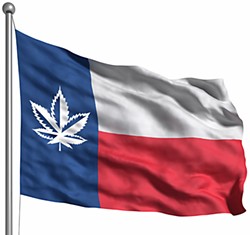
Momentum builds for Lone Star legalization of marijuana

BY JORDAN SMITH, FRI., MARCH 14, 2014

Don't Fear the Reefer!
ILLUSTRATION BY JASON STOUT/THINKSTOCK
For more than a decade, Austin Demo­cratic state Rep. Elliott Naishtat has brought to his Capitol colleagues a modest proposal: Create an affirmative defense to prosecution on pot possession charges for seriously ill Texans.
For seven sessions now – that's every other year since 2001 – he's either authored or sponsored a measure that would give bona fide patients – those suffering, for example, from AIDS, multiple sclerosis, glaucoma, cancer – the ability to have a judge decide if a criminal charge for pot possession should be dismissed. Naishtat's proposal would also protect doctors who suggest their patients try marijuana as medicine to alleviate the debilitating symptoms of disease.
And he's been clear, at every turn, that this is all the bill would do. He hasn't suggested that the state legalize medical marijuana – as 20 states and the District of Colum­bia have done – let alone that Texas follow the lead of Colorado and Washington and legalize marijuana outright for all uses. "I try to be moderate," he says, and proposed this bill, specifically, because "I thought it would have a snowball's chance."
That isn't exactly how it's played out. The measure has only three times been assigned a committee hearing – once by the House Criminal Jurisprudence Committee (back in 2001) and then by the House Public Health Committee, in 2005 and again in 2013. No version of the bill has ever received a vote in committee, let alone made it to the House floor for consideration.
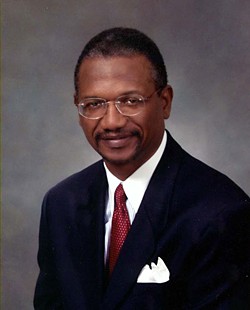
Rep. Harold Dutton
Rep. Harold Dutton
It's frustrating, certainly, but Naishtat is unsurprised and remains undaunted by the repeated roadblocks. In part, that's because he knows what lawmakers say to him in hushed tones on the floor: Sure, what you're doing makes sense, and it's the right thing to do, but I can't vote for it. "I have members come up to me and say, 'I know what you're trying to do here, but I can't vote for it because my cousin in Harlingen is a deputy sheriff,' or because 'I can't look weak on crime. Maybe in another six years.'"
Yet if recent poll numbers are to be believed, it shouldn't take anywhere near six years to get this done. According to a September 2013 poll commissioned by the Marijuana Policy Project, a majority of all Texas voters – men and women, Democrats, Republicans, and independents – support legalizing medi-pot. In a Texas Tribune/UT poll released in February, 49% of voters favor making at least small amounts of pot legal for any purpose, and another 28% favor legalizing medi-mari – thus, a clear 77% of all voters (a slight majority of those polled were Republican) favor legalizing medi-pot, and most certainly would favor Naishtat's bill. He says, "I'm saying with more confidence it's just a matter of time until it's legalized."
Indeed, since January, when Gov. Rick Perry said (during a panel discussion of the World Economic Forum in Switzerland) that he supports marijuana decriminalization – and the right of individual states to legalize the drug outright – the Texas media has been trolling for more. The Dallas Morning News asked Democratic gubernatorial candidate Wendy Davis about her views in a recent interview; she would support medi-pot, she responded, and the right of voters to consider legalization (though she said she's not sure how she'd vote on that question). Land Commissioner and recent GOP lite guv candidate Jerry Patterson told public television station KERA, without hesitation, that he would support legalizing medical marijuana; and author/musician Kinky Friedman's all-pot-all-the-time race for agriculture commissioner netted him 38% of Democratic party voters, the most in the three-way race, sending him to a May run-off.
These are among the recent and public shifts that veteran lawmakers and advocates for drug-law reform consider harbingers of big things to come for the Lone Star State. It's just a matter of time, they say, before Texas goes all in for lasting marijuana-law reform. The question is how quickly things will move, and what shape the future will take.

Change Follows Experience

The way state Rep. Harold Dutton, D-Hous­ton, sees it, all this talk about changing pot laws was inevitable. As Naishtat has fought long and hard to protect medical marijuana patients, so too Dutton has pressed – and pressed and pressed – to decriminalize possession of small amounts of pot, making possession of up to an ounce a fine-only offense. "[I]t appears that everyone else is getting as smart as I am," he said. "It's like you take a match and strike it and somehow or another the forest catches on fire and you have no idea how that happened. But it's a good thing. It focuses on what criminal laws are designed to do: Protect people. How can you say that's what you're doing when you take a 20-year-old kid and arrest him [for possessing a joint]?" Dutton asks.
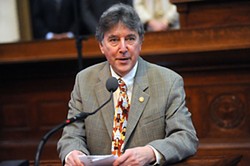
Rep. Elliott Naishtat
PHOTO BY JOHN ANDERSON
Like Naishtat's bill, Dutton's is a modest proposal (it keeps jail time on the table for possession of two ounces or more) that has gained only limited traction since 2005, when he first introduced it. Last year it made the most progress, voted out of the Criminal Jurisprudence Committee – with crucial Tea Partier support – before disappearing into the Calendars Committee, never to find a date with the House floor.
Nevertheless, Dutton remains confident that his bill, too, will soon pass. "You have to realize how the Legislature operates," he said. "Remember the 'blue laws'? Trying to repeal the blue laws, people would say, 'More people are going to go to hell if you can shop on Sunday!' I think we have as many people going to hell now, but it took seven sessions to get that done." In short, he said, "People get very conservative about holding on to past statutes" – even where they serve no good purpose. And like Naish­tat, Dutton has heard his colleagues lament that they'd love to vote for his bill, but can't. Yet he insists that if he keeps pressing long enough, his colleagues will come around and the job will get done. "One [House] member called me and told me he was against [my bill, but] that when his son was arrested for marijuana, he changed his mind," Dutton recalled. "Once you get some real experience, it changes things."

No More Harm: 'Legalize It'

For sure, decriminalizing – or even outright legalizing – marijuana in Texas would bring a lot of benefits, advocates say, such as a noticeable reduction in criminal justice expenses, including the cost to lock up non-violent low-level drug offenders popped for possession. According to the FBI, in 2012, 82.2% of all drug arrests in the U.S. were for possession only; of those, 42.4% were arrested for marijuana possession. In Texas the numbers are even starker: In 2012, according to the Texas Department of Pub­lic Safety, 57% of the 116,634 adult arrests for drug possession, and a whopping 81% of the 8,132 juvenile arrests for drug possession, were for possession of pot. Consider a low-level offender popped for pot and sentenced to a year in county jail – in Austin that costs taxpayers an average of $38,548 per inmate per year.
Those are the kinds of numbers that make retired narcotics officer Russell Jones shake his head. Jones, who worked for the San Jose, Calif., police department and did foreign intelligence work before retiring to Central Texas in 1994, now works with the drug-law reform advocacy group Law Enforcement Against Prohibition, as well as with the Drug Policy Forum of Texas, giving talks to anyone who wants to listen about why the War on Drugs is an utter and complete failure and should be put out of its misery.
Among the biggest reasons, Jones says, is that policing drugs does way more harm than the drugs themselves, particularly among youth and young adults who get caught up in the drug war dragnet. The consequences of a single possession arrest can be haunting – taking away the opportunity to go to college, to enter a profession of choice. And for what? "Throwing people in jail and saddling them with a drug conviction, you're doing a whole lot worse than the drug use" did, he said, particularly when the vast majority of people simply grow out of it. "The vast majority don't get addicted," he said. "So what's the least harmful way to deal with [drug use]?" To Jones the answer is to fully legalize it: Decriminalization, he says, still leaves production and distribution in the hands of the black market – including the cartels working up into Texas from the Mexico border. He believes that legalizing marijuana in Texas would impose order on an underground business and, quite literally, save lives. "When was the last time we had a drive-by shooting between Bud and Coors? It doesn't happen, because it's a legal product," he said. "We've got to stop ruining kids' lives over youthful indiscretions."

Rob Kampia, Marijuana Policy Project
Jones, like Naishtat, believes strongly that it's only a matter of diminishing time before medical marijuana is legal in Texas; Dutton believes decriminalization is on tap for the 2015 legislative session. But all three are more skeptical of when, or if, Texas will actually go all in to legalize marijuana. "I can't imagine making it legal," said Dutton, "but I think decriminalization is something Texas is going to do next session."

The Tipping Point?

Despite Dutton's understandable skepticism, there's at least one deep-pocketed advocate who believes not only that Texas will legalize marijuana, but that change is right around the corner. That's Rob Kampia, co-founder and executive director of the Marijuana Policy Project, which has backed nearly every successful marijuana initiative since the group's founding in the mid-Nineties, and was the driving force behind the 2012 vote to legalize pot in Colorado.
Now, Kampia is bringing that winning spirit to Texas; beginning March 1, the group hired its first-ever Texas lobbyist and has committed to spending $200,000 a year here until the job is done. Like Dutton and Naishtat, Kampia's heard plenty of lawmakers list all the reasons why pot-law reform simply won't work in their state. He's been taken into closed-door meetings where lawmakers say in hushed tones, "I just don't know if I can support this." Sure you can, Kampia responds, because "marijuana polls better than you do." That has been the case in any number of states where MPP has, eventually, prevailed despite conventional wisdom to the contrary. Indeed, the recent Texas Tribune/UT poll results reflect that voters favor some form of legalization (49%) more strongly than they approve of the job Gov. Rick Perry (42%) has done. "I've learned over the last 15 years, people in the state in question believe change is not possible in their state, but [is] possible in other states," he said. "We feel like legalizing marijuana in Texas – though people in Texas feel like it's impossible – I think it's possible in five years."
The tide is visibly turning against pot prohibition – at press time, legalization measures had been introduced or were pending in 17 states, while medi-pot legalization measures had made it into 14 state houses. Moreover, the rhetoric against marijuana-law reform has become increasingly tired, if not desperate. Case in point: In testifying against a legalization measure pending in Maryland, Annapolis Police Chief Michael Pristoop told lawmakers that more than 30 people overdosed on marijuana on the first day it was legalized in Colorado. In contrast, he said, "No one's overdosing on beer." Unfortunately for Pristoop, the Colo­rado "pot-OD" story was a hoax, created by the satirical website Daily Currant, and no one at all had "overdosed" on marijuana (virtually an impossibility). By contrast, according to the Centers for Disease Control, there are approximately 88,000 deaths each year attributable to excessive alcohol use – something a police chief should know well.
Pristoop subsequently apologized for mistaking the OD story as a factual account, but to reform advocates, the incident highlights the lengths to which some opponents would go to in order to avoid change. "This just underscores why we should not be treating drug issues with a law enforcement approach," says Tom Angell, founder of Marijua­na Majority.
Kampia, who expects voters in as many as six states could legalize marijuana in the 2016 election cycle, says it's time to "take reality for what it is, and move forward." In Texas, he believes that time has come. "We're in and we're in for the long haul," he said. "We're ready to go."
Naishtat says he's talked with MPP about its plans, and he supports those efforts, although, for now at least, he'll continue to push his moderate measure in the hope that, finally, his colleagues will agree that seriously ill Texans deserve their support. "I think we're getting close to the tipping point, in light of what is happening across the country," he said. "Maybe ... the eighth time [is the charm], or the ninth. But I know we're making progress."


Marijuana legalization in Indiana

from elkharttruth.com


A Portage lawmaker says Colorado has shown Indiana how much money a state could make through marijuana legalization.
Carlin Yoder talks during an interview at The Elkhart Truth Friday, Oct. 12, 2012. Yoder, a Republican Indiana state senator, doesn't support marijuana legalization but thinks it is "inevitable." (Jennifer Shephard/The Elkhart Truth)
Krystal Vivian
Posted at 2:20 p.m.
Some say it's only a matter of time before Indiana decriminalizes marijuana.
As of Jan. 1, Colorado became the first state to sell recreational marijuana. The amount of money already made in the first month has turned the head of one Indiana lawmaker.
Indiana Sen. Karen Tallian, D-Portage, has introduced marijuana decriminalization bills in the past few sessions, but it has not passed yet,WTHR-TV in Indianapolis reports. 
She said that Colorado showed Indiana how much money is in marijuana legalization, so she might introduce another bill next year.
"Maybe I'll try medical marijuana, maybe that will get them," Tallian told WTHR. "Or maybe I just try the whole legalization program, I'm not sure what I'll do, but it's time for Indiana to do something."
But Indiana Sen. Carlin Yoder, R-Middlebury, said legalizing marijuana just for the revenue is the wrong action.
"Drugs are not healthy for families and society and it's a mistake to go down the path to legalize it as a product. It's not all about revenue," he said. "We make enough money from gambling and other sin taxes and I'm very skeptical we need to look for new ways to gain revenue by legalizing drugs."
But that doesn't necessarily mean that Yoder believes marijuana legalization is out of the question for Indiana.
"I think it probably is inevitable, but that doesn't mean I'm going to step aside and let it happen," he told WTHR.
Elkhart County Prosecuting Attorney Curtis Hill said in early Februarythat he's not in favor of decriminalizing pot, as it it's a gateway drug and won't help crime issues where pot is often associated. 
What do you think? Should Indiana legalize marijuana? Let us know what you think in the comments below.


Wednesday, March 5, 2014

Gupta: 'I am doubling down' on medical marijuana

from cnn


By Dr. Sanjay Gupta, CNN Chief Medical Correspondent
updated 3:12 PM EST, Wed March 5, 2014


Editor's note: Don't miss "Weed 2: Cannabis Madness: Dr. Sanjay Gupta Reports," at 10 p.m. ET on Tuesday. Also, Dr. Gupta will be answering your questions on Reddit at noon ET Friday.
(CNN) -- It's been eight months since I last wrote about medical marijuana, apologizing for having not dug deeply into the beneficial effects of this plant and for writing articles dismissing its potential. I apologized for my own role in previously misleading people, and I feel very badly that people have suffered for too long, unable to obtain the legitimate medicine that may have helped them.
I have been reminded that a true and productive scientific journey involves a willingness to let go of established notions and get at the truth, even if it is uncomfortable and even it means having to say "sorry."
It is not easy to apologize and take your lumps, but this was never about me.
This scientific journey is about a growing number of patients who want the cannabis plant as a genuine medicine, not to get high.
Dr. Sanjay Gupta is a practicing neurosurgeon and CNN\'s chief medical correspondent.
Dr. Sanjay Gupta is a practicing neurosurgeon and CNN's chief medical correspondent.
It is about emerging science that not only shows and proves what marijuana can do for the body but provides better insights into the mechanisms of marijuana in the brain, helping us better understand a plant whose benefits have been documented for thousands of years. This journey is also about a Draconian system where politics override science and patients are caught in the middle.
Since our documentary "Weed" aired in August, I have continued to travel the world, investigating and asking tough questions about marijuana.
I have met with hundreds of patients, dozens of scientists and the curious majority who simply want a deeper understanding of this ancient plant. I have sat in labs and personally analyzed the molecules in marijuana that have such potential but are also a source of intense controversy. I have seen those molecules turned into medicine that has quelled epilepsy in a child and pain in a grown adult. I've seen it help a woman at the peak of her life to overcome the ravages of multiple sclerosis.
Georgia House approves medical marijuana
Fla. to vote on medical marijuana
Can medical marijuana help seizures?
I am more convinced than ever that it is irresponsible to not provide the best care we can, care that often may involve marijuana.
I am not backing down on medical marijuana; I am doubling down.
I should add that, although I've taken some heat for my reporting on marijuana, it hasn't been as lonely a position as I expected. Legislators from several states have reached out to me, eager to inform their own positions and asking to show the documentary to their fellow lawmakers.
I've avoided any lobbying, but of course it is gratifying to know that people with influence are paying attention to the film. One place where lawmakers saw a long clip was Georgia, where the state House just passed a medical marijuana bill by a vote of 171-4. Before the legislative session started, most people didn't think this bill had a chance.
More remarkable, many doctors and scientists, worried about being ostracized for even discussing the potential of marijuana, called me confidentially to share their own stories of the drug and the benefit it has provided to their patients. I will honor my promise not to name them, but I hope this next documentary will enable a more open discussion and advance science in the process.
Marijuana is classified as a Schedule I substance, defined as "the most dangerous" drugs "with no currently accepted medical use."
Neither of those statements has ever been factual. Even many of the most ardent critics of medical marijuana don't agree with the Schedule I classification, knowing how it's impeded the ability to conduct needed research on the plant.
Even the head of the National Institute on Drug Abuse, Dr. Nora Volkow, seems to have softened her stance; she told me she believes we need to loosen restrictions for researchers.
Along the way, the public has become intensely engaged. Our collective society has paid closer attention to this issue than ever before, and with that increased education, support for medical marijuana has only grown, including in some unexpected places.
Pete Carroll, the coach of the Super Bowl-winning Seattle Seahawks, said the National Football League should explore medical marijuana if it helps players. NFL Commissioner Roger Goodell hasn't dismissed the idea, saying that if marijuana is reconsidered by the medical establishment, the league would treat it the same as any other medicine. Goodell also says the NFL is following the science that suggests marijuana may help recovery from concussions.
Recently, I had the chance to tell him that the United States already holds a patent on medical marijuana for that very purpose. Patent No. 6630507: Cannabinoids are found to have particular application as neuroprotectants, for example in limiting neurological damage following ischemic insults, such as stroke or trauma.
However, this particular issue still bothers me: How can the government deny the benefits of medical marijuana even as it holds a patent for those very same benefits? Members of the Food and Drug Administration declined my repeated requests for an interview.
This past year, President Barack Obama told the New Yorker magazine, "I don't think (marijuana) is more dangerous than alcohol." And yet, as alcohol remains available to any adult, the president has not moved to remove marijuana from the list of the most tightly controlled substances in the country.
Since I started my reporting on this topic, I have mostly resisted temptation to inject a subjective moral equivalency into this discussion, such as pitting alcohol against marijuana or reminding you that cocaine and methamphetamine are actually more available than marijuana to patients, physicians and medical researchers: They are Schedule II drugs, with recognized medical uses. Or telling you that on average, a person dies every 19 minutes in this country from a legal prescription drug overdose, while it is virtually unheard-of to die from a marijuana overdose.
But, with a discussion like this, consistency does matter. Terms matter, too.
We are talking about a medicine, known scientifically as cannabis. In order for people to start thinking of this substance as a medicine, perhaps we should start calling it by its medical name, something that was suggested to me by medical marijuana advocates pretty much everywhere I went this year.
I've tried to pull together these latest developments in our new documentary, "Cannabis Madness." Although the 1936 film "Reefer Madness" was propaganda made to advance an agenda with dramatic falsehoods and hyperbole, I hope you will find "Cannabis Madness" an accurate reflection of what is happening today, injected with the best current science.
You will meet families all across the country -- a stay-at-home mom from Ohio, a nurse practitioner from Florida, an insurance salesman from Alabama -- more than 100 families who have all left jobs, homes, friends and family behind and moved to Colorado to get the medicine that relieves their suffering.
As things stand now, many of these good people don't ever get to return home. Why? Because transporting their medicine, even if it is a non-psychoactive cannabis oil, could get them arrested for drug trafficking. And so they are stuck, cannabis refugees.
You will meet them, and if you're like me, you'll be heartbroken to hear their stories, but you'll also have a lump in your throat when you see the raw, true love these parents have for their sick children.
History books may one day draw a parallel between this chapter of medical marijuana and the story of David and Goliath. Playing the role of David's slingshot, which ultimately brought Goliath to his knees, would be a 2-year-old girl named Vivian Wilson. She inspired her father to challenge the system in a spectacular way that caused a nation to stop for a moment and take note.
For months, we have filmed and followed the Wilson family with all of their trials and tribulations, and you will meet the whole family in the upcoming documentary.
I am a father myself, first and foremost. I don't want my children taking or being offered a psychoactive substance. As a neurosurgeon, I know that the developing brain is more susceptible to the most harmful effects of cannabis and that brain development continues well into our mid-20s.
I also worry that generations from now, my great-grandkids will find Internet headlines referring to me as the "pot doc." I do hope they will also read the rest of the story and understand the lives of the countless people who have suffered needlessly when a plant could have helped. I hope they know that I have dedicated my time to researching the medical literature, speaking to the scientists in person and piecing together a fact-based presentation meant to educate, not frighten.
I hope future generations won't consider me naive. Yes, I know there is a concern that many people out there will feign ailments just to get marijuana. But withholding legitimate treatment for the needy is a very unjust way of addressing that concern.
As a physician and reporter, I feel a deeper obligation to present the real stories, soundly supported with the science from all over the world.
When I first apologized for my previous marijuana reporting, I was thinking about the impact that reporting may have had on Charlotte Figi. She is a sweet little girl whose brain was locked in nearly nonstop seizure activity. Without success, she tried seven different medications, stringent diets and high-dose supplements. Modern medicine had nothing more to offer, which is why her parents turned to an ancient plant. As you know, it worked.
And, as you will see, she is one of so many patients out there, suffering from different ailments, who believe cannabis rescued them when nothing else did.
For conditions like Charlotte's, the American Epilepsy Society says that there are a million people for whom existing therapies do not control their seizures. The society recently said anecdotes about medical marijuana "give reason for hope" and said it supports "well-controlled studies that will lead to a better understanding of the disease and the development of safe and effective treatments."
You should know that Charlotte continues to do well. When I saw her around the holidays, she ran over and gave me a hug. She looked me in the eyes, took me by the hand and led me all around to meet her friends. She is a delightful, happy and now healthy little girl.
I know the discussion around this topic will no doubt get heated. I have felt that heat. But I feel a greater responsibility than ever to make sure those heated discussions are also well-informed by science.
And, with that: I hope you get a chance to watch on March 11 at 10 p.m. Eastern.